It’s 4 p.m. on Friday afternoon. Seton Catholic football players shuffle in and out of the athletic training room on the side of McMahon Gym to get taped or to receive other treatment before the Sentinels’ game against rival Marcos de Niza on Nov. 5.
Typically Seton’s full-time athletic trainer Brianna Saltzman is in the middle of action with all three training tables occupied. However, she is nowhere near the athletic training room.
A group of her sports medicine students and interns assist with the football game preparation. Saltzman is busy helping one of the girls basketball players who suffered an allergic reaction during the team’s preseason practice.
While attending to the girl, Saltzman called the player’s parents to come pick her up. She also called 911 and had the Chandler fire department come to provide assistance as well.
“There are a lot of instances where a lot of these kids said they haven’t had someone be present, whether it’s at school events, club events,” said Saltzman, who oversees about 300 Sentinel athletes. “Having someone on the sideline for them is really nice. That’s helped us build the relationships.”
Seton Catholic is a part of the 37% of private high schools nationally that have a full-time athletic trainer, according to a 2019 Korey Stringer Institute study that was published in the Journal of Athletic Training. About a third of all high schools (private and public) have no access to an athletic trainer, according to a 2019 Reuters article.
“If you have sports at your school, you need to have [an athletic trainer] there in some capacity,” said Dr. Casey McKay, the owner of AT Direct Sports Medicine. “People always say it’s a money thing. Ok, well, so is a lawsuit when you get sued. With concussions being a big thing, it’s important for somebody to be there and diagnose and evaluate. There’s a lot of things we can do that can help athletes not be hurt.”
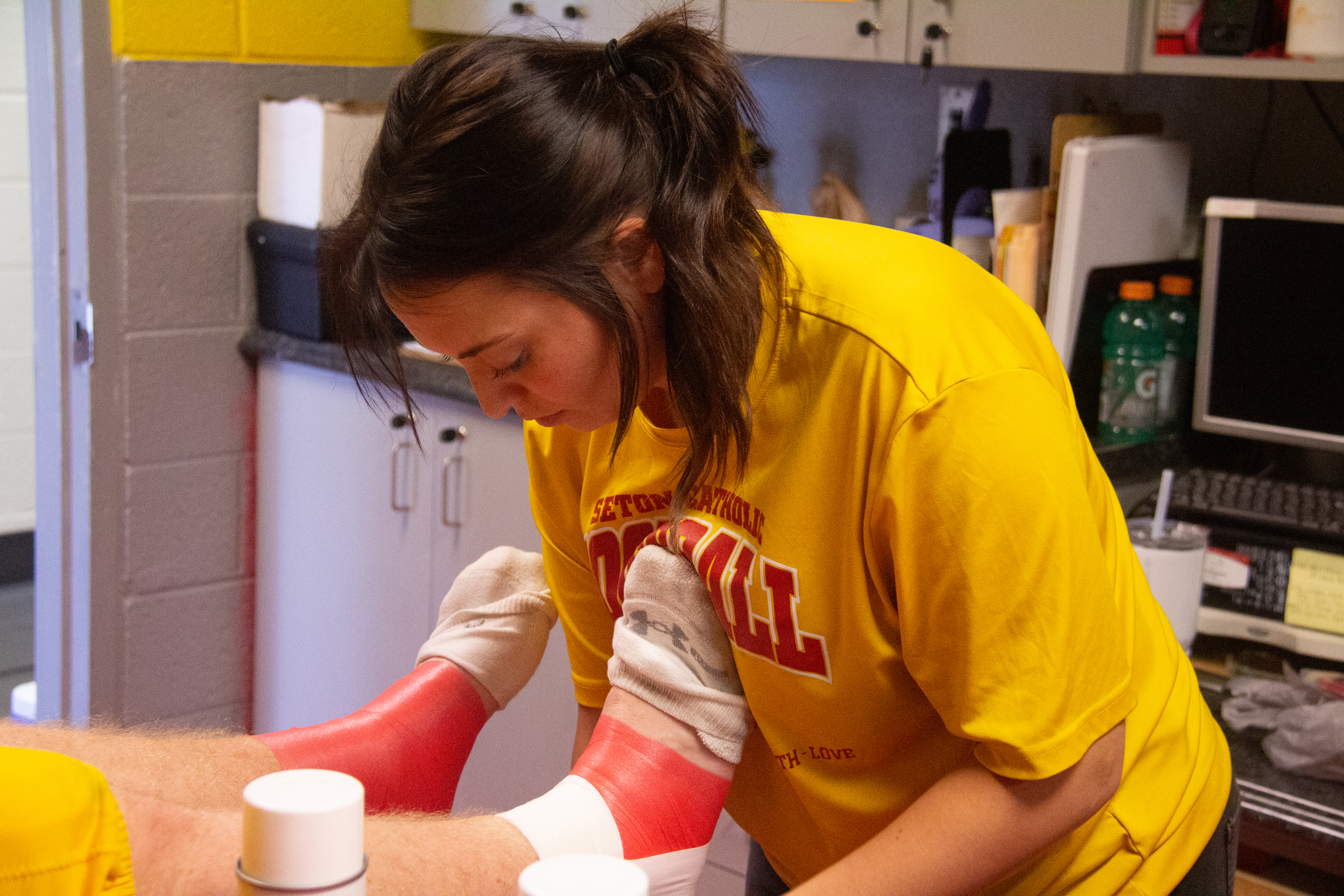
Athletic trainers can diagnose and treat injuries as well as see athletes through their recovery from start to finish. They are also one of the five groups of health care providers that can legally diagnose, treat and clear concussions in Arizona.
Injuries and concussions are not the only things on Saltzman’s plate as she also teaches sports medicine at Seton Catholic. Friday is the longest day of the week for her. She teaches in the morning and then spends the afternoon preparing for football as well as practices or games for other teams.
During the football game, she is on the sideline treating any injuries that come up and handing out water to the players as the come off the field. After the game, Saltzman and her students clean up the Gatorade and water jugs as well as the water bottles and medicine kits. Saltzman provides treatment to whichever players need it. Saturday mornings she is back at Seton at 7 a.m. for practice.
“She is the backbone of our football program,” offensive coordinator Mario Ortega said. “She keeps us coaches in line. She is committed 100%. Uniquely, she is here during the summer, during the offseason, helping out.”
Seton Catholic has had a full-time athletic trainer for about a decade. Saltzman is in her second year at the Chandler school.
“I don’t think I’ve met a better athletic trainer, just in regards to how much she cares for the kids,” Assistant Athletic Director Terry Licht said. “It’s been very impressive to see her grow in the rapport with the coaches, with the kids.”
Licht credited Saltzman with making the student-athletes comfortable enough to come to her with even a minor injury. He said there has been a stigma in sports around going to the athletic trainer, but she has helped to break helped to break it down.
One instance in which that happened was a soccer player who tweaked her leg. She knew something was wrong and asked Saltzman about it. She is now scheduled for an ACL surgery.
“[Athletic trainers] build relationship with coaches, parents, administrators, athletes,” said Dr. David Mesman, the president of the Arizona Athletic Trainers’ Association. “Having a full-time athletic trainer in a school, building those relationships actually helps prevent injuries down the road just from having those relationships.”
Saltzman also played a pivotal role with an injury Ortega’s daughter suffered. Aliana, who is a sophomore at Seton and plays basketball and softball, had some pain in foot and ankle. She spoke to Saltzman about it, who checked her out and recommended she seek help from a specialist and physical therapy. They found her patellofemoral tracking was off and gave her some exercises to complete, which she did with Saltzman.
“We’d still be running in circles if Bri wasn’t here,” Mario Ortega said. “We thought it was in the foot or an ankle injury. It wasn’t until Bri kind of gave her professional opinion and said I think it’s more of the knee… She’s helped build my daughter’s confidence, not only in the rehab part, but you know the mental confidence to get back out there.”
Saltzman’s students marvel at how she keeps track of all the athletes who play on just one team, let alone the entire athletics department of 23 varsity teams.

“There are so many athletes out on the field that you have to wonder how she has so many thoughts going through her head,” senior Kamryn Benvin said.
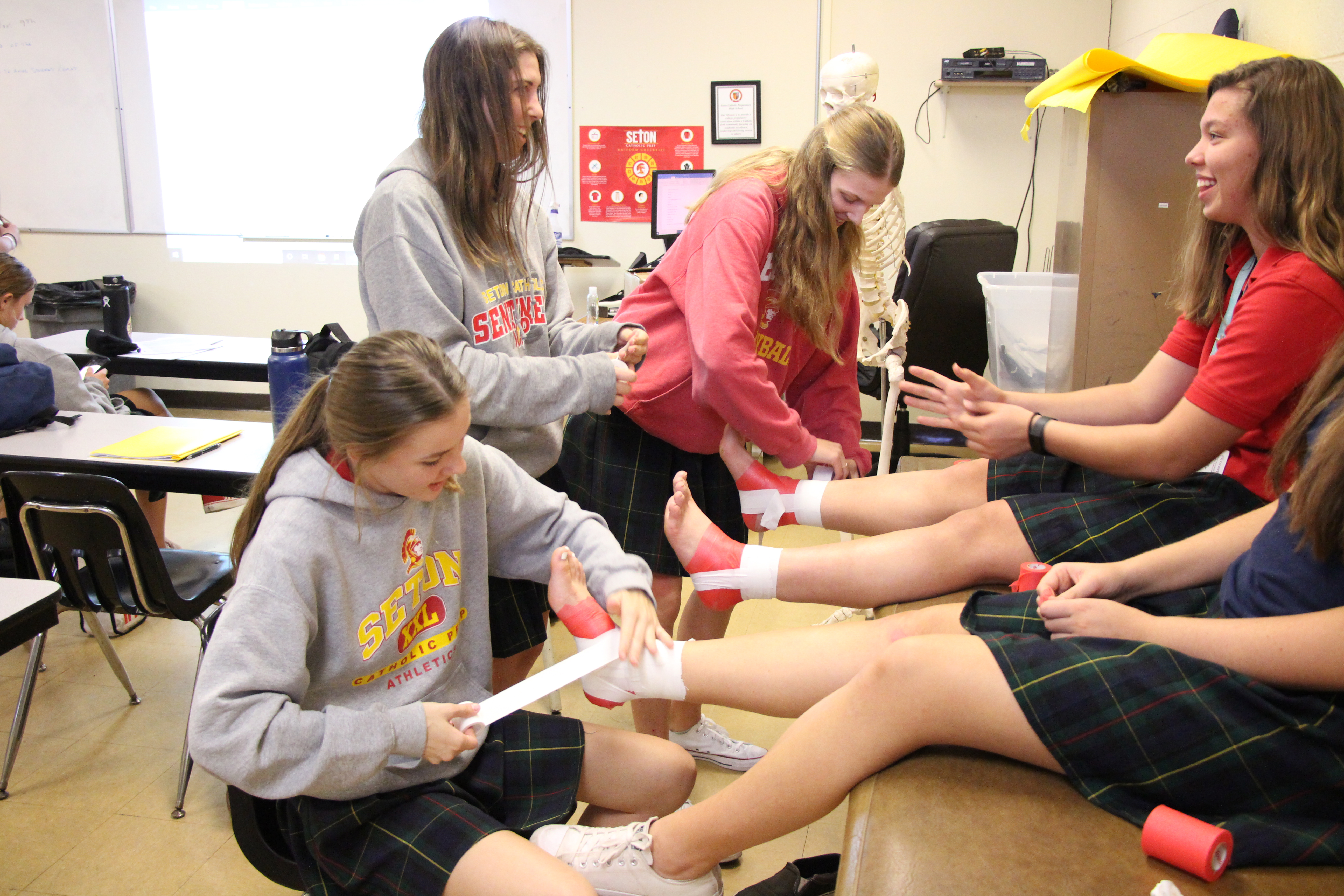
Benvin is one of the students in Saltzman’s sports medicine class. In the course, which lasts one semester, the students learn about the different body parts, how to stretch properly and what goes into successful rehab.
“It’s just an overall great foundation,” said Sarah Krick, a senior who is in Saltzman’s class and is a member of the soccer team. “I got to learn about all the bones, the ligaments, tendons and muscles and a whole bunch of different injuries.”
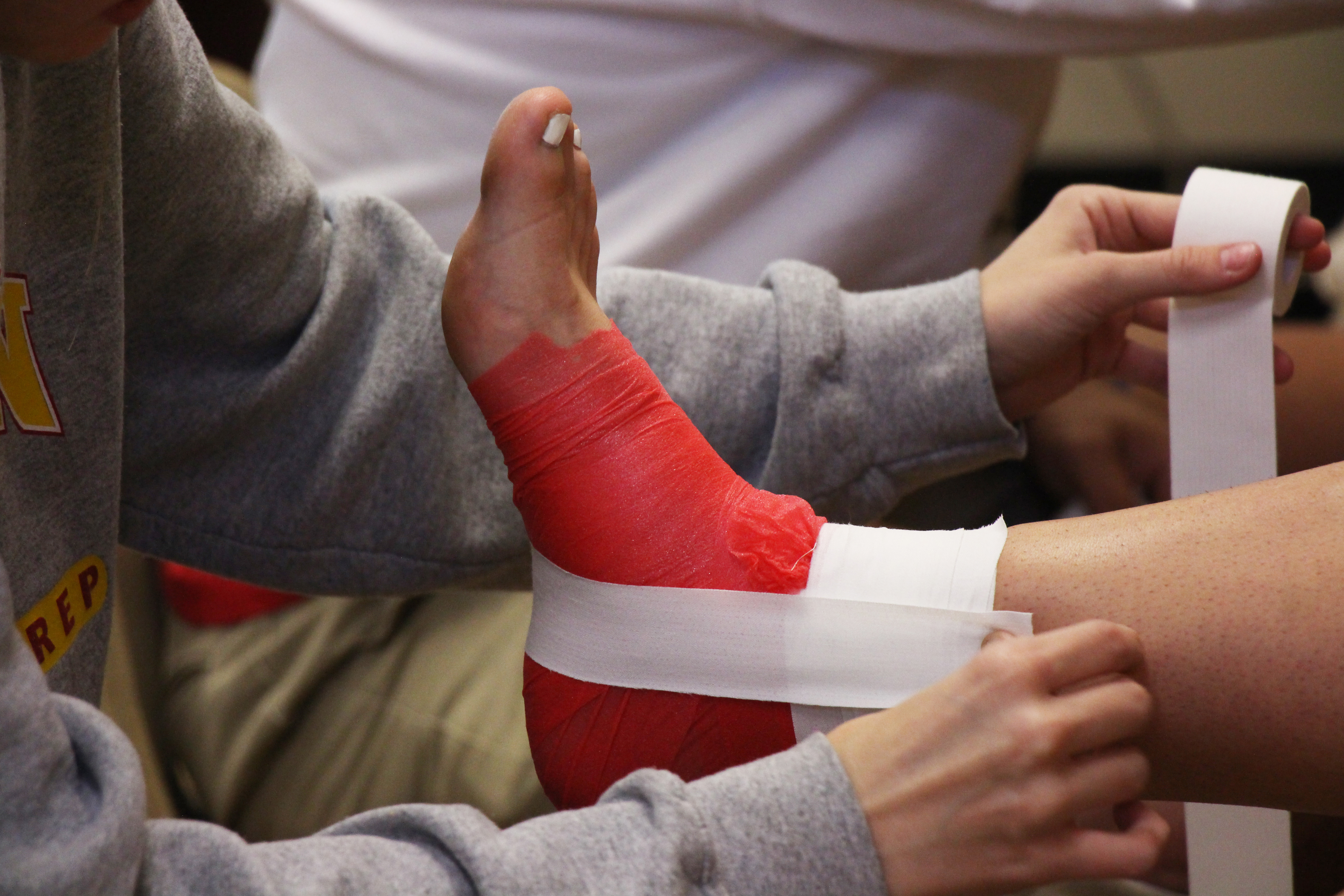
About 75-80% of high school athletic trainers around the country also teach at their schools, according to Mesman. The Seton sports medicine class meets four times a week. On Monday, Tuesday and Wednesday, it is more of a lecture-style session. On Friday mornings, Saltzman conducts a lab session.
“It’s kind of cool that the kids get to learn that in school,” Licht said. “A lot of them end up helping in the athletic training room, so it’s great real-world experience. I wish more schools did programs, not even for sports med, but just in general more professional programs like that because it really does help the kids see the value in what [athletic] trainers do.”
While the role of athletic trainer and sports medicine teacher falls solely on the shoulders of Saltzman at Seton Catholic, some local high schools have larger sports medicine departments.
Sandra Day O’Connor High School has three athletic trainers who also teach. Students who enroll in the sports medicine class there also receive credit from Rio Salado College in Tempe, according to KOLD News 13.
Queen Creek has two full-time athletic trainers. McKay serves as one of them and used to teach sports medicine but does not anymore. The other athletic trainer teaches one section of the class. The school also has a full-time teacher, who has five sections of sports medicine.
“Teaching and doing athletic training is a lot,” McKay said. “The schools do it because it saves them money, which sucks. I wish that bigger schools did not do it. Smaller schools where you don’t necessarily need an athletic trainer there all the time, 40 hours a week, it makes more sense, but the bigger schools, there’s no way. It’s too much.”
At Seton Catholic, Saltzman estimates she works about 60 hours a week between serving as athletic trainer and teacher. She teaches during the school day and remains on campus into the night for practices and games. Frequently there are multiple sports going on at the same time, so her attention is split between the different practices and games.
“I wish we could have two trainers like some of the big schools do,” Licht said. “Some of those big schools should have three or four just because it’s so necessary. Necessary, not only for the kids and making sure they’re taken care of, but also taking care of the trainers themselves.”
Saltzman spoke about the high burnout rate among athletic trainers. The profession features long hours, low pay and a heavy workload, which causes an unhealthy work-life balance. She added that some athletic departments lack the infrastructure to fully support their athletic trainers, though she claimed Seton has been fully supportive over her two years.
“Athletic trainers at this level don’t go into it for the money or the prestige,” Saltzman said. “They go into it because they truly do care about the athletes. They want to be someone that can make an impact and help their students.”
 Ian Sacks
Leave a comment